Employee Shift Scheduling Software for Small Business
Employee Shift Scheduling Software for Small Business: 7 Key Benefits The hidden operational shift that stops labor leakages, eliminates manager burnout, and puts your roster on autopilot.
At 11:14 PM on a Friday evening, a single text message can destroy a small business owner’s entire week. You are staring at a brightly lit phone screen, looking at a message from your lead barista or head server explaining that they have a family emergency and cannot make tomorrow’s 6:00 AM opening shift. In that silent, frustrating moment, you realize you do not just have a staffing problem; you have a systemic architecture problem. You spend the next two hours firing off desperate text messages to off-duty employees, begging for last-minute coverage, while scrambling to remember who is already nearing overtime limits and who holds the necessary keyholder certification. This chaotic midnight scramble is the daily reality for thousands of entrepreneurs who still rely on static spreadsheets, paper rosters, or chaotic messaging group chats. Installing a dedicated employee shift scheduling software for small business is no longer a luxury upgrade—it is the foundational boundary that separates scaling enterprises from exhausted owners.
The Illusion of Manual Roster Control
Managers often believe that keeping shift scheduling inside a custom spreadsheet gives them total control and saves monthly software subscription costs. You line up rows of employee names, color-code shift blocks, and feel a temporary sense of accomplishment once every cell is filled.
BUT static spreadsheets are passive tools that operate in a vacuum, completely disconnected from human reality. They do not alert you when you accidentally schedule an employee for a "clopening"—working a late closing shift followed immediately by an early morning opening shift. They do not calculate real-time overtime accumulation, nor do they track whether an employee’s mandatory food safety certificate expired three days ago.
Worst of all, the moment you publish a static spreadsheet, it is already obsolete. As soon as one employee requests a change, a cascade of administrative edits begins, creating multiple conflicting versions of the truth. Staff end up looking at outdated screenshots, leading to missed shifts, costly no-shows, and heated disputes over who was actually supposed to be working.
Static spreadsheets do not save money; they simply convert software costs into invisible labor leakages, compliance risks, and manager exhaustion.
Transitioning to Dedicated Scheduling Architecture
THEREFORE, growing companies must abandon static document files and adopt dedicated employee shift scheduling software for small business to establish a single, authoritative source of truth.
When your entire workforce operates from a unified cloud platform, the "which version is real?" question vanishes instantly. Every single schedule update, shift adjustment, or time-off approval broadcasts live to every team member's mobile device in real time.
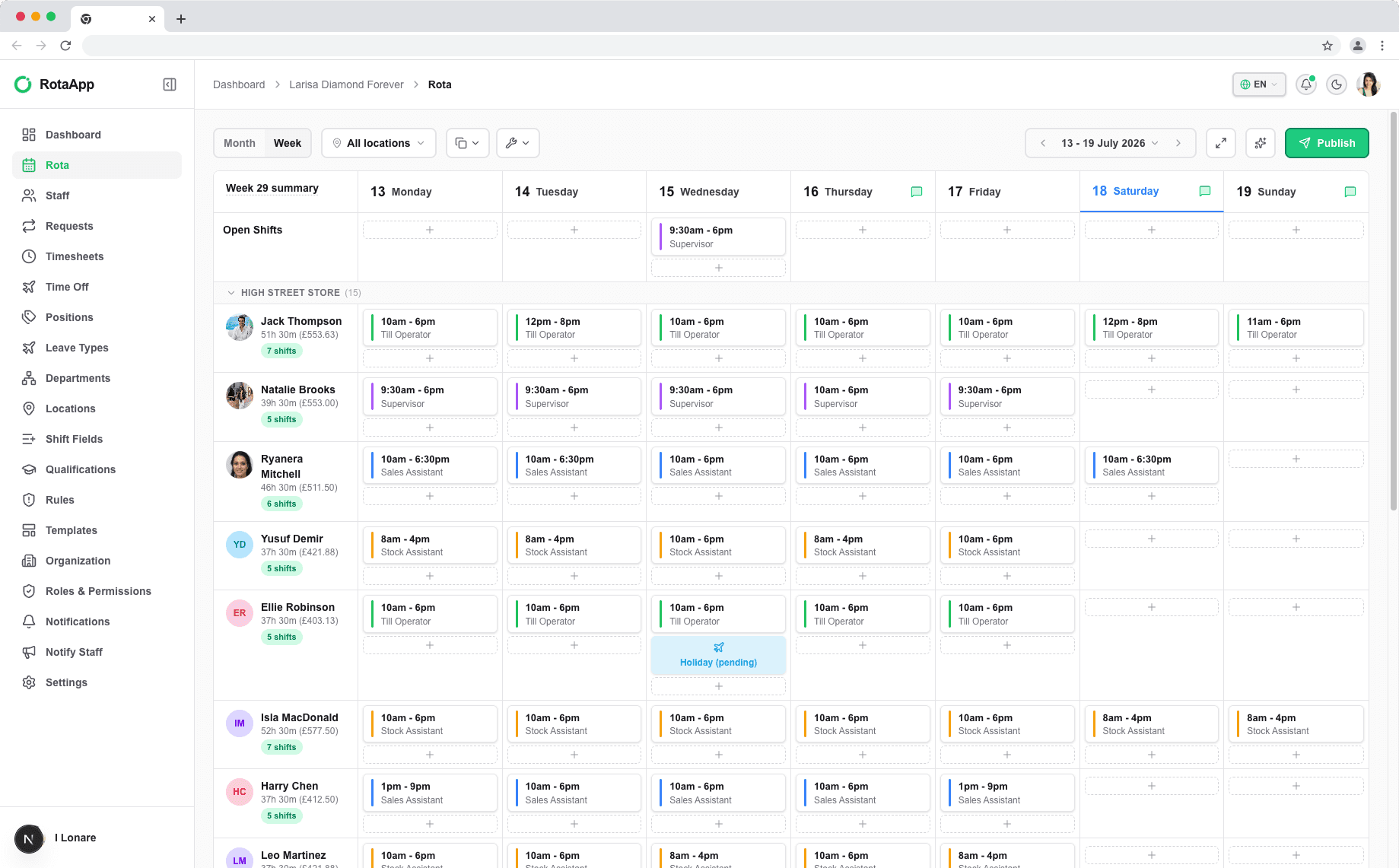
Centralized Visibility: Managers build and view schedules across multiple roles, departments, or physical store locations from one intuitive central dashboard.
Live Mobile Access: Hourly workers receive instant push notifications whenever a new roster is published or modified, ending morning text-blast confusion.
Automated Timesheet Syncing: Published shifts seamlessly connect with digital time-clock tools, preventing time-card padding and simplifying payroll exports.
By consolidating all shift data into a dedicated cloud environment, small business owners immediately win back five to ten hours of administrative effort every single week.
Digital Calendars Fail When Human Life Happens
BUT simply digitizing a rigid top-down schedule into a PDF or cloud calendar still fails to address the unpredictable nature of hourly workforces.
Life is inherently dynamic. Staff get sick, college students face sudden exam conflicts, and child-care arrangements fall through without warning. When a top-down digital schedule encounters a sudden real-world disruption, the full administrative burden of finding replacement coverage falls entirely back onto the manager’s shoulders.
The manager becomes an uncompensated middleman, spending hours calling individual team members, mediating schedule requests, and manually re-editing calendar entries. This bottleneck creates massive friction, frustrates staff who feel micromanaged, and leaves the business constantly vulnerable to short-staffed shifts during peak revenue hours.
Unlocking Frictionless Peer-to-Peer Swaps and Open Pools
THEREFORE, modern scheduling systems decentralize coverage management by placing self-service scheduling tools directly into the hands of the workforce.
Instead of forcing managers to act as dispatchers, high-efficiency platforms empower staff to manage shift trades independently. Dedicated platforms such as RotaApp showcase how intuitive this process can be for frontline workers.
Through intuitive mobile interfaces, employees who cannot work a scheduled slot can initiate peer-to-peer shift swapping directly with qualified colleagues. Alternatively, if a worker cannot find an immediate one-to-one trade, they can drop their shift back into a centralized open shift pool. Eligible, off-duty team members receive immediate alerts and can claim the open shift in seconds.
Peer-to-Peer Trades: Staff swap equivalent shifts with colleagues in seconds without cluttering team communication channels.
Open Shift Distribution: Unassigned or dropped shifts move to an open pool, letting eager employees pick up extra hours voluntarily.
Frictionless Manager Approval: Simple one-tap manager approvals ensure leadership retains complete oversight without doing the heavy administrative lifting.
Decentralizing schedule adjustments turns shift coverage from a stressful manager bottleneck into a collaborative, community-driven process.
Unregulated Swaps Introduce Operational and Compliance Risks
BUT allowing completely unmonitored peer-to-peer shift trades creates a dangerous operational hazard for small business owners.
If two employees swap shifts informally without system checks, a Junior Line Cook might trade with a Senior Kitchen Manager, leaving a busy weekend dinner rush without a qualified supervisor on duty.
Even worse, unrestrained employee trades can accidentally trigger expensive overtime liabilities or violate local labor laws. In many jurisdictions, predictive scheduling laws, local rest-period regulations (such as mandatory 11-hour breaks between shifts), and strict minor-labor laws carry severe financial penalties for non-compliance. An unvetted shift trade can turn a simple schedule swap into a costly regulatory violation.
Automating Precision with AI Rota Generators
THEREFORE, modern employee shift scheduling software for small business incorporates intelligent artificial intelligence engines to enforce regulatory boundaries and operational rules automatically.
Instead of forcing human managers to memorize hundreds of changing variables, an AI rota generator evaluates thousands of data combinations in real time. When generating a schedule from scratch or evaluating a proposed shift swap, the AI engine processes key operational metrics instantly:
Live Employee Availability: Checks real-time time-off requests, preferred working hours, and personal commitments.
Skill Sets and Certifications: Ensures specific shifts contain required qualifications, such as first-aid certification, keyholder authority, or specialized equipment licenses.
Position Optimization: Matches exact job roles—such as cashiers, floor managers, or kitchen prep—to predicted customer traffic demands.
Local Rules and Regulations: Enforces mandatory break durations, weekly hour caps, overtime thresholds, and local labor law requirements continuously.
Smart AI engines do not replace managerial oversight; they act as an invisible compliance shield that prevents expensive operational errors before they happen.
The Fear of Algorithmic Control
BUT many small business owners hesitate to implement AI scheduling, fearing that automated algorithms will output cold, rigid rosters that ignore human nuances.
There is a widespread myth that artificial intelligence creates impersonal work environments, treating employees like replaceable numbers in a spreadsheet. Managers worry that an automated system will fail to understand that two specific employees work poorly together, or that a long-time worker prefers morning shifts due to childcare needs.
If an AI tool operates without human guardrails, it risks damaging workplace culture, eroding trust, and creating schedules that look mathematically perfect on paper but fail completely on the shop floor.
Blending AI Precision with Human Oversight
THEREFORE, the most successful small businesses adopt a hybrid scheduling model that combines raw algorithmic processing power with essential human leadership intuition.
Modern scheduling software does not take away managerial authority; it enhances it. The AI rota engine creates a mathematically optimized, fully compliant draft schedule in seconds. The human manager then reviews, fine-tunes, and approves the roster, making soft-skill adjustments that no algorithm could anticipate.
One-Click AI Generation: The system drafts a complete weekly roster aligned with sales forecasts, budget targets, and employee availability.
Visual Exception Flagging: The software highlights potential conflicts, fatigue risks, or unassigned skill positions in red, allowing rapid manual edits.
Final Manager Approval: Leadership holds absolute final publish control, maintaining the personal touch essential for small business success.
By taking care of tedious math, labor limits, and availability matching automatically, the software allows managers to focus on coaching their teams, elevating customer service, and growing the business.
The Hidden Cost of Rigid Schedules in an On-Demand Economy
BUT even the most perfectly optimized schedule will cause high employee turnover if it remains rigid and uncompromising in today's modern employment landscape.
Hourly workers today expect flexibility, transparency, and respect for their personal lives. When businesses enforce rigid, unpredictable schedules with last-minute shifts and zero input from staff, employee satisfaction plummets. High turnover costs small businesses thousands of dollars per employee in recruitment, onboarding, and lost productivity.
A business that relies on friction-heavy scheduling methods creates a toxic cycle of burn-out, chronic absenteeism, and costly operational churn.
Building a Resilient Workforce for Long-Term Growth
THEREFORE, implementing smart employee shift scheduling software for small business serves as a powerful talent retention tool that transforms your workplace culture.
When staff have mobile access to predictable schedules published weeks in advance, the ability to initiate peer-to-peer trades easily, and transparency into open shifts, their job satisfaction increases dramatically.
Respecting employee time through transparent, flexible scheduling technology is the single most cost-effective retention strategy a small business can deploy.
Reduced Turnover: Predictable scheduling and self-service flexibility increase retention among skilled hourly workers.
Lower Labor Waste: AI demand matching prevents accidental overstaffing during slow hours while protecting against understaffing during revenue peaks.
Flawless Compliance: Automated tracking eliminates local labor law fines and guarantees auditable records for regulatory peace of mind.
The Future Architecture of Small Business Workforces
The landscape of small business workforce management is shifting rapidly. As labor markets evolve and predictive compliance laws become stricter across regions, businesses relying on static spreadsheets will face escalating labor costs and operational friction.
The future belongs to agile, tech-enabled small businesses that view shift scheduling not as an administrative chore, but as an automated operational engine. By combining peer-to-peer shift swaps, open pools, and AI-driven compliance checks, smart business owners eliminate the late-night scheduling panic forever.
Will your scheduling systems adapt to empower your workforce, or will your next midnight text message send your business into another chaotic tailspin?